
Mauritius Finance Act 2026: Income Tax Rate Restructuring, Expatriate Tax Exemption & Lump-Sum Thresholds Increased
The Mauritius Finance Act, enacted on 12 August 2026, introduces significant amendments to the Income Tax Act affecting payroll, personal taxation, and employee benefits. The Act brings three major changes effective from various dates: a restructured income tax rate scale, a new tax exemption for qualifying expatriate employees, and an increased exemption threshold for lump-sum payments.
Mauritius Income Tax Rates Restructured: Effective 1 July 2026
New Income Tax Rate Structure
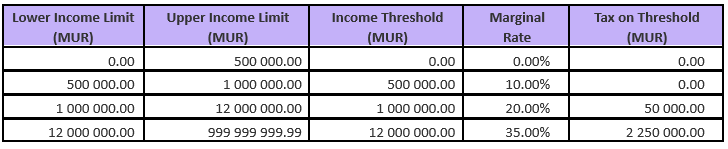
The income tax rate bands are amended effective from 1 July 2026. The new rate structure replaces the previous progressive scale with four distinct tax brackets:
- Income exceeding 0 but not exceeding MUR 500,000 is taxed at 0%.
- Income exceeding MUR 500,000 but not exceeding MUR 1,000,000 is taxed at 10%.
- Income exceeding MUR 1,000,000 but not exceeding MUR 12,000,000 is taxed at 20%.
- Income exceeding MUR 12,000,000 is taxed at 35%.
Fair Share Contribution Replaced by 35% Tax Band
A significant change introduced by the Finance Act is the replacement of the individual Fair Share Contribution with a new 35% income tax bracket for income exceeding MUR 12,000,000.
- The 35% tax band replaces the Fair Share Contribution for individuals.
- The application of the individual Fair Share Contribution is limited to the income year from 1 July 2025 to 30 June 2026.
- The Fair Share Contribution no longer applies from 1 July 2026 onwards.
Important: Fair Share Contribution Phase-Out
The Fair Share Contribution previously applied to high-income earners. This tax has been completely replaced by the new 35% marginal tax rate on income above MUR 12,000,000 effective 1 July 2026. Employers and high-income earners should ensure payroll calculations are updated to reflect this change.
Expatriate Income Tax Exemption for Solar Manufacturing: Effective 1 July 2026
Four-Year Tax Exemption for Qualifying Non-Citizen Employees
A new four-year income tax exemption is introduced for qualifying non-citizen employees, effective from 1 July 2026 and every subsequent income year.
- Exemption Duration: The exemption runs for four consecutive income years, commencing with the income year in which employment begins.
- Qualifying Employment: The exemption applies only to non-citizen employees who are employed wholly and exclusively for installation, commissioning, or operation of a manufacturing plant producing solar photovoltaic systems.
- Scope: This is a sector-specific incentive designed to attract skilled expatriate talent to the renewable energy manufacturing sector in Mauritius.
Important: Strict Eligibility Conditions
This exemption requires that the non-citizen employee work wholly and exclusively on solar photovoltaic manufacturing activities. Any work outside this scope may disqualify the employee from the exemption. Employers must document employment purposes and keep records demonstrating that the employee's duties align with installation, commissioning, or operation of solar PV manufacturing plants.
Lump-Sum Exemption Threshold Increased: Effective 19 June 2026
Increased Threshold for Pension & Severance Payments
The exemption threshold for lump-sum payments has been increased, providing relief for employees receiving pension, retiring allowance, or severance payments.
**Payment Type: **Pension, Retiring Allowance & Severance
**Previous Threshold: **MUR 3,000,000
**New Threshold (From 19 June 2026): **MUR 3,500,000
The increased exemption threshold provides greater tax relief on lump-sum termination and retirement payments, effective 19 June 2026.
Important: Early Effective Date
Note that the lump-sum exemption threshold increase became effective on 19 June 2026—earlier than the 1 July 2026 date of the other amendments in the Finance Act. Any lump-sum payments made on or after 19 June 2026 will benefit from the increased MUR 3.5 million exemption threshold.
Summary of Finance Act 2026 Changes
The Finance Act 2026 brings substantial changes to Mauritius's income tax framework. These reforms simplify the tax structure with a new four-bracket system, introduce targeted incentives for renewable energy sectors through the expatriate exemption, and provide increased relief for lump-sum retirement and severance payments. Employers and employees should review these changes carefully to ensure compliance and optimal tax planning.